- Tel: +86-18852916580
- Suzhou CERS Commercial Equipment Co., Ltd.
- Email: [email protected]
- Tel: +86-18852916580
- Suzhou CERS Commercial Equipment Co., Ltd.
- Email: [email protected]


 Español
  عربى
عربى  Deutsch


What Are the Different Types of Display Hooks: Practical Applications, Selection
Content
- 1 The Core Types of Display Hooks: Five Families That Cover Most Retail Aisles
- 2 Matching Display Hooks to Product Weight and Package Size
- 3 Pegboard, Slatwall, Grid, or Beam: How the Panel Decides the Hook
- 4 Merchandising Layout Rules That Keep Display Hooks Productive
- 5 Load Ratings, Wire Gauge, and Finish: Safety Checks Before You Order
- 6 Choosing a Supplier: What to Verify Before You Buy Display Hooks
- 7 Frequently Asked Questions About Display Hooks
When a supermarket merchandising manager resets a gondola aisle, display hooks rarely get the same attention as the shelf planogram. Three weeks later the evidence shows up: a bent single-prong hook under a 4 kg bag, packages tilting because the hook is shorter than the pack depth, and an endcap with the front item pulled and the rest twisted. Those are fixture geometry problems, not product problems.
The different types of display hooks and how to use them for merchandising can be reduced to one practical division: single-wire hooks for light items, double-wire hooks for heavy or wide packs, slatwall and grid hooks for their mounting surfaces, and specialty hooks for fragile or high-theft SKUs. Once that division is clear, the rest is mechanical: verify the panel, weigh the heaviest unit, measure pack depth, then add 30 percent load headroom.
Work in order: panel decides the hook family, package weight decides wire strength, package depth decides arm length.
The Core Types of Display Hooks: Five Families That Cover Most Retail Aisles
Every retail display hook belongs to one of five families: single-wire, double-wire, slatwall, grid-panel, and specialty beam hooks. The family name tells you where it mounts and how many wires carry the load.
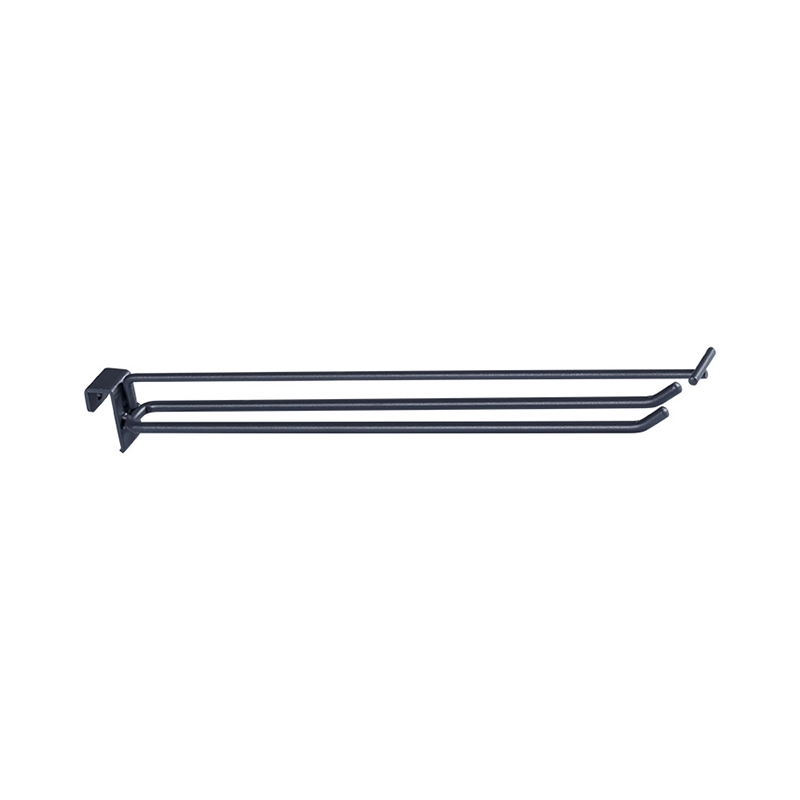
Single-wire hooks are the workhorse of pegboard walls; double-wire hooks double the load path and stop wide packs from tilting. Slatwall hooks slide into grooves and suit soft goods. Grid-panel hooks wrap over the horizontal wires of grid walls. Specialty hooks include ball-end tips, bowl racks, L-hooks, and multi-bead anti-drop designs.
| Display hook family | Mounting surface | Typical load | Best merchandising use |
| Single-wire pegboard hook | Perforated hardboard | 2-6 kg | Blister packs, hangers, light bags |
| Double-wire pegboard hook | Perforated hardboard | 8-15 kg | Bagged rice, pet food, heavy tooling |
| Slatwall hook | Slatwall channel | 3-8 kg | Tagged soft goods, caps, hanging accessories |
| Grid-panel hook | Wire grid panel | 3-6 kg | Hardware, cosmetics, impulse items |
| Beam-mounted hook | Shelf beam or bar | 10-20 kg | Bulk goods, endcap back-stock, heavy packs |
| Specialty hook | Varies by design | 1-5 kg | Fragile packs, single facings, anti-drop displays |
Matching Display Hooks to Product Weight and Package Size
Match the hook to the package: weight selects the wire family, depth selects arm length, rigidity selects the prong type. A 2 kg blister pack, a 5 kg bag of rice, and a 12 kg pet food pouch all fail on the same hook.
A single wire pressed against a soft bag makes the bag slump, which is why double-wire hooks are standard for bagged products above 3 kg. Rigid blister packs hold their shape on a single prong.
Rated loads for steel display hooks with 4-6 mm wire diameter and welded prongs, based on typical static test values.
For rigid packs under 5 kg, a thickened single-prong pegboard hook supports the pack without visible deflection and stays straight under repeated handling.
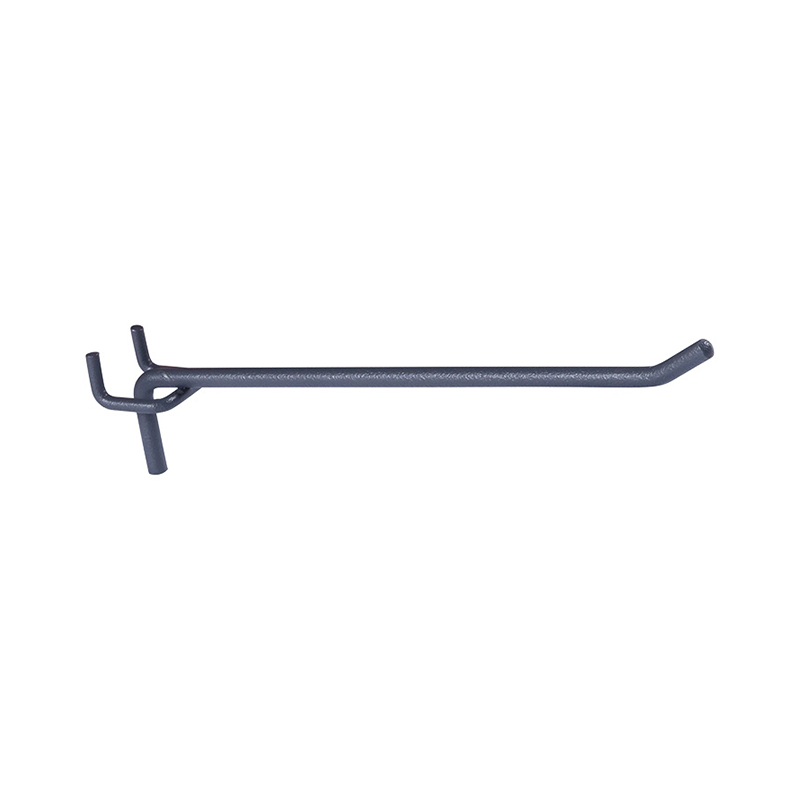 Extra-Thick Pegboard Single-Prong Hook for Heavy ItemsThis extra-thick single-prong pegboard hook supports rigid packs under 5 kg without visible deflection and stays straight under repeated handling. Available in seven lengths from 100 to 400 mm, it suits tools, automotive accessories, and bulk-packaged products. Confirm your panel type before ordering.View Product →
Pegboard, Slatwall, Grid, or Beam: How the Panel Decides the Hook
The mounting panel is the first filter in display hook selection; a pegboard hook will not lock into a slatwall channel, and a grid hook cannot slide onto a slatwall groove. Confirm the panel before ordering hooks.
Pegboard hooks lock into round holes with a prong and heel; slatwall hooks slide into the groove; grid hooks bend over a horizontal wire; beam hooks wrap around a shelf flange. Each mount changes the load angle and reset effort.
- Dense, flexible planograms
- Easy to relocate during resets
- Panel strength limits heavy loads
- Hole or wire spacing must match hook pitch
- Continuous horizontal mounting line
- Supports heavier packaged goods
- Fewer relocation points for small resets
- Beam hooks free up shelf deck space
Merchandising Layout Rules That Keep Display Hooks Productive
Layout decides whether a display hook sells the item or buries it: block vertically, keep one SKU per hook, and hold fast movers at eye level.
- Measure pack depth and width before assigning hook length; a short arm tilts the pack, a long arm cuts facings.
- Assign one SKU per hook and run at least three facing hooks for strong movers; visual mass sells more.
- Keep fast movers between 130 and 160 cm from the floor; slower items go lower, impulse items higher.
- Audit weekly for bent prongs and empty hooks; replace any hook whose angle differs from its neighbors.
For fragile packages, use a ball-end or multi-bead anti-drop hook. The bead lets a customer take one piece while blocking the rest from sliding off, and it slows grab-and-run theft.
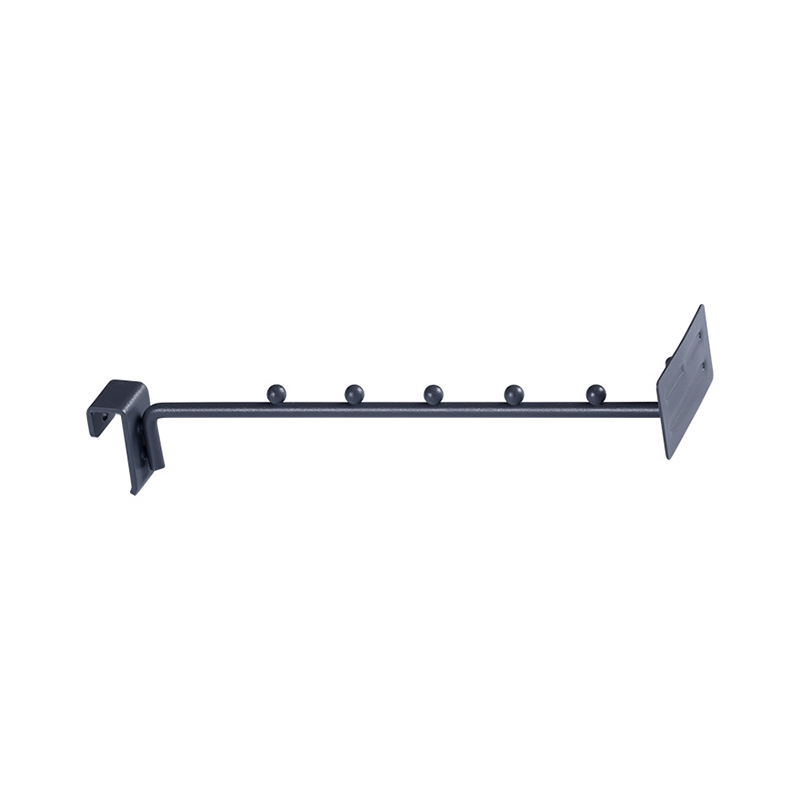 Multi-Bead Anti-Drop Display Hook for SupermarketsThis multi-bead anti-drop hook lets customers remove one item while blocking the rest from sliding off, helping prevent grab-and-run theft. It is designed for lightweight apparel like bras, lingerie, and scarves, with lengths from 100 to 400 mm and optional anti-slip sleeves.View Product →
Load Ratings, Wire Gauge, and Finish: Safety Checks Before You Order
Load rating on a display hook is a tested value, not a description; verify wire diameter, weld quality, and coating.
Single-wire hooks typically use 4 to 5 mm wire and hold 2 to 6 kg; double-wire hooks use 5 to 6 mm wire and hold 8 to 15 kg. The weld between prong and back plate fails first: a quality weld has no cracks and survives a bend test without opening.
- Load test certificate for each hook series
- Material certificate for the steel wire
- Batch inspection record with weld checks
- Factory access for audit or video tour
- No production line to inspect
- No batch record, only one sample approved
- Coating quality varies between shipments
- Load values copied from the original manufacturer
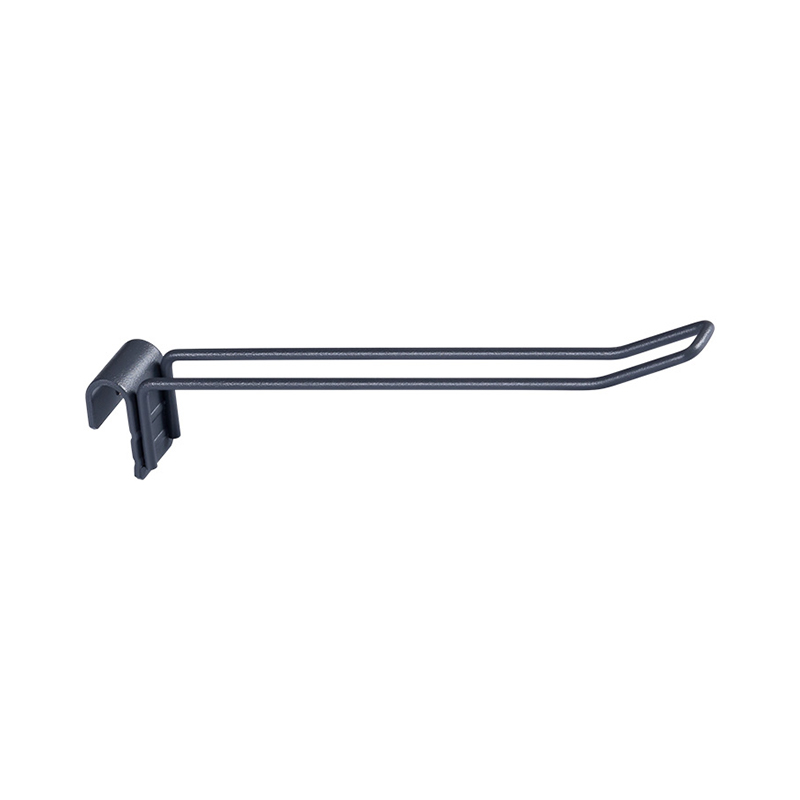
For bags over 3 kg, use a double-wire hook: two wires distribute the weight and stop rotation, so tagged items stay on the wire during a full facing pull.
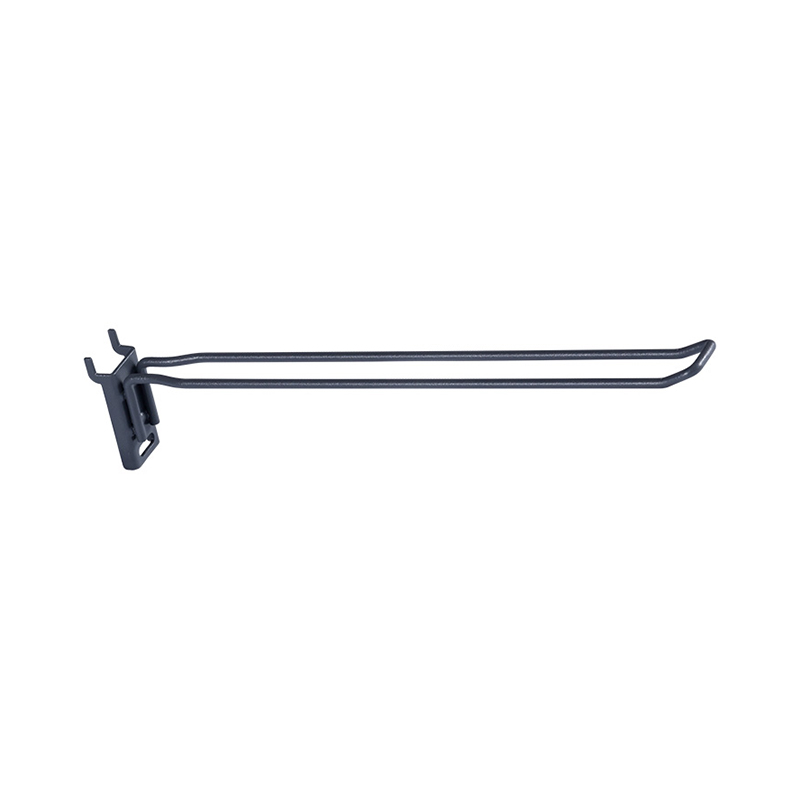 Pegboard Double-Wire Hook for Heavy LoadsThis dual-rod pegboard hook distributes weight across two parallel wires, reducing rotation and keeping tagged items secure during facing pulls. It suits bags over 3 kg, tool sets, and bulk items. Seven lengths from 100 to 400 mm are available.View Product →
Choosing a Supplier: What to Verify Before You Buy Display Hooks
A dependable display hook supplier can show you the factory, the test bench, and the coating line; if any is missing, the load rating is only a promise.
Suzhou CERS Commercial Equipment Co., Ltd. has manufactured retail display equipment for over a decade from a 12,000-square-meter facility near Shanghai, producing load-rated single-wire and double-wire hooks alongside supermarket shelving, guardrails, shopping carts, and baskets. Because the same factory builds the perforated panels and display racks, hooks and panels can be matched in one order, which avoids fit and finish mismatches on the gondola.
- Request the load test certificate for the exact hook series you plan to buy.
- Ask for the steel grade and wire diameter in the quotation.
- Confirm coating type: zinc-plated, epoxy, or powder coated.
- Ask whether the factory can batch-match hooks with perforated panels and shelves.
- Verify export packaging; poor packing bends prongs before the container arrives.
For a complete store fitting and retail display solutions package, an integrated manufacturer simplifies planogram planning and mixed-container shipping. CERS also publishes a full equipment catalog and a buyer FAQ, so technical questions do not need to wait for a phone call.
Frequently Asked Questions About Display Hooks
Can one display hook fit both pegboard and slatwall panels?
No. Pegboard hooks lock into round holes with a prong and heel, while slatwall hooks slide into the channel groove. A universal hook usually compromises the locking angle on at least one panel, so confirm the panel type before ordering.
How much weight can a single-wire display hook hold?
A typical 5 mm single-wire pegboard hook holds 4 to 6 kg in static testing, used with a 30 percent headroom margin. Above about 3 kg, verify the rated load rather than assuming the package label weight is safe.
What is the difference between single-prong and double-prong hooks?
A single-prong hook gives one wire of support, fine for rigid packs under 3 kg. A double-prong spreads the load across two wires, stops wide or soft bags from tilting, and suits heavier goods.
How long should a display hook be for a deep package?
Use 70 to 80 percent of package depth as a starting point. A 30 cm deep bag works well on a 21 to 24 cm hook; when in doubt choose the shorter hook, because an over-long arm invites pulling and front-edge damage.

- Quick Links
- Home
- About Us
- Sustainable
- News
- Contact Us
- Products
- Supermarket shelf
- Storage rack
- Shopping cart
- Shopping basket
- Shelving Accessories
- Display rack
- Contact us
-
-
+86-18852916580

-
[email protected]

-
No. 9 Yongxin Road, Wangzhuang Industrial Park, Shanghu Town, Changshu City, Jiangsu Province, China

-

