- Tel: +86-18852916580
- Suzhou CERS Commercial Equipment Co., Ltd.
- Email: [email protected]
- Tel: +86-18852916580
- Suzhou CERS Commercial Equipment Co., Ltd.
- Email: [email protected]


 Español
  عربى
عربى  Deutsch


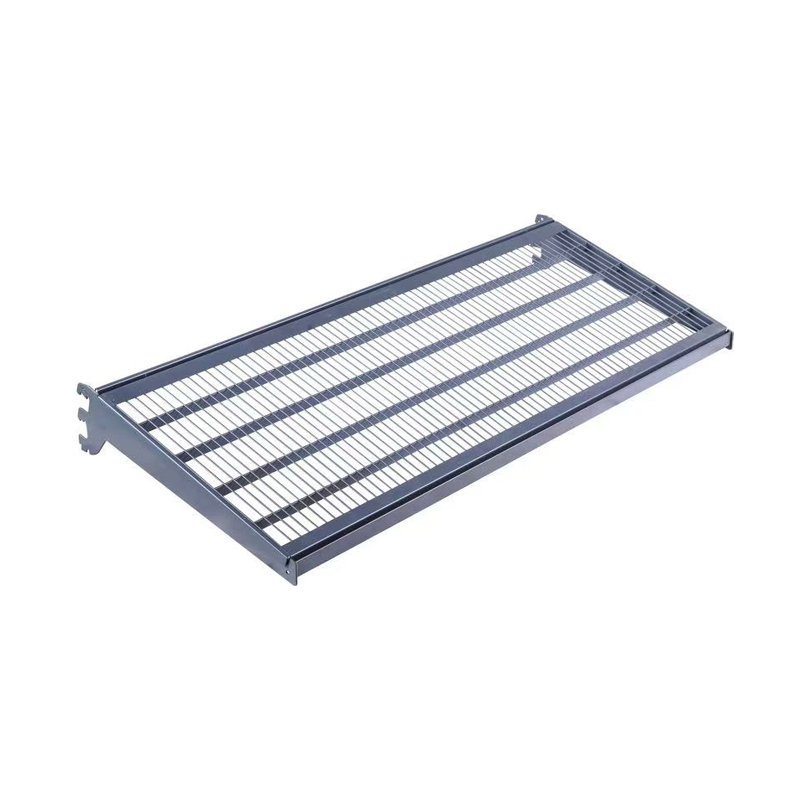
Retail Shelf Wire Decking — Universal Shelf Board
This wire decking is a universal replacement shelf board for retail shelving, designed to replace wood or plastic shelf panels and install on shelf beams. The product is welded from metal wire into a flat panel shape with reinforced edges on all four sides. Six standard size specifications are available: lengths of 1000 mm or 1200 mm; widths of 370, 470, and 570 mm. Suitable for displaying various products in supermarkets, convenience stores, and warehouse shelving. The wire mesh structure provides breathability and visibility, with a powder-coated or galvanized rust-resistant finish.

L*W:1000*370/1000*470/1000*570/1200*370/1200*470/1200*570mm
Core Advantages
Breathable structure – Mesh open area: 50% to 70%, allowing air circulation above and below the shelf panel. Suitable for products requiring ventilation (produce, bagged dry goods) and beverage cans with condensation from coolers. Moisture drains through mesh openings, reducing surface water accumulation on products.
Load capacity – Wire diameter: 3.5 to 4.5 mm. Frame edges reinforced with thicker wire or flat bar. Per-shelf load range: 50 to 150 kg depending on dimensions. Mesh structure distributes loads evenly, preventing deformation from concentrated loads.
Size specification matching – Six standard sizes cover common shelf depth and length requirements. Lengths 1000 mm or 1200 mm fit standard single-span shelf beams. Widths 370, 470, and 570 mm fit different beam depths. After installation, all four edges overlap the beams with an overlap width of 15 to 30 mm.
Installation convenience – Panels sit directly on shelf beams without tools. Downward flanges or locating slots on all four edges engage with beams, preventing panel sliding. For removal, lift the panel upward.
Product Features
Material – Carbon steel wire, diameter options: 3.5, 4.0, 4.5 mm. Frame edge material: carbon steel wire (diameter 5.0 to 6.0 mm) or flat bar (thickness 3.0 to 4.0 mm, width 10 to 15 mm).
Size specifications (L × W) :
1000×370 mm
1000×470 mm
1000×570 mm
1200×370 mm
1200×470 mm
1200×570 mm
Thickness (height) – 25 to 40 mm (including frame and wire height).
Mesh pattern – Vertical wire spacing: 25 to 50 mm. Horizontal wire spacing: 50 to 100 mm.
Wire diameter – 3.5, 4.0, 4.5 mm options.
Frame specifications – Reinforced edges on all four sides with downward flanges. Flange height: 10 to 20 mm, flange angle: 90 degrees.
Surface finish – Electrostatic powder coating (black, white, gray) or hot-dip galvanizing.
Per-shelf load capacity (evenly distributed across panel surface) :
1000×370 mm: 50-70 kg
1000×470 mm: 60-80 kg
1000×570 mm: 70-90 kg
1200×370 mm: 80-100 kg
1200×470 mm: 90-110 kg
1200×570 mm: 100-130 kg
Compatible shelf types – Standard supermarket shelving and warehouse shelving (beam spacing matches panel length, inner beam width matches panel width).
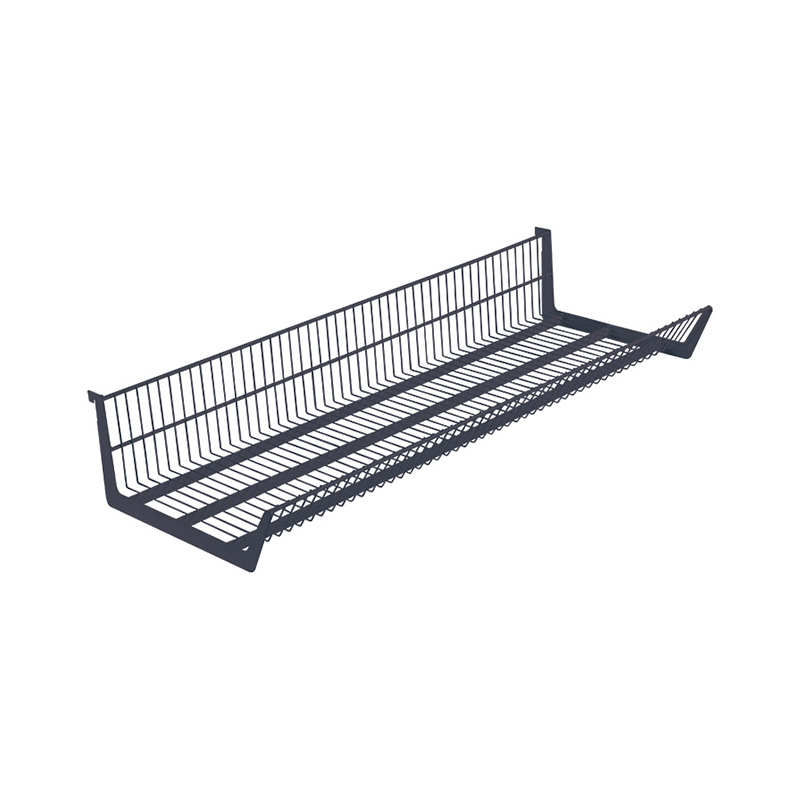
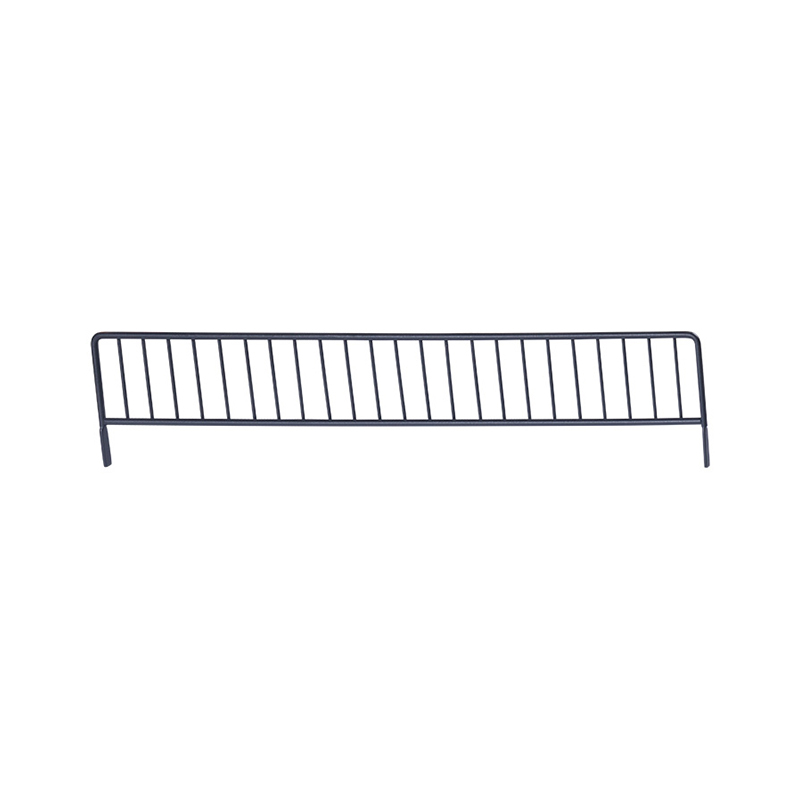
Accessory options – Anti-slip pads (adhesive on frame bottom), divider slots (welded to panel surface), front guardrail (clips to panel front edge).
Application Scenarios
Beverages, condiments, and canned goods are displayed on supermarket shelving.
Bottled water and beverage panels in convenience store coolers.
Hardware parts and small accessory storage on warehouse shelving.
Bagged fruit and vegetable displays in produce stores (ventilation required).
Miscellaneous item organization on home storage racks.
Frequently Asked Questions and Precautions
Frequently Asked Questions
Q: What are the load performance differences between wire decking and wood/plastic shelf panels?
A: At equivalent thickness, wire decking has higher bending stiffness than wood panels but lower than solid steel panels. The mesh structure transfers localized loads (e.g., heavy items placed at a single point) through the mesh to the frame and beams, distributing stress and resisting local indentation. Wood panels develop compression marks under localized loads, while plastic panels may creep under high temperatures or long-term loads.
Q: How to select the correct panel width?
A: Panel width should equal or be slightly less than the inner beam width (front-to-back direction). 370 mm for inner beam widths of 350 to 380 mm; 470 mm for 450 to 480 mm; 570 mm for 550 to 580 mm. After installation, front and rear edges overlap beams with a minimum overlap of 15 mm. Over-wide panels cannot fit between beams; under-wide panels may shift front-to-back.
Q: Does wire decking rust?
A: Standard powder coating is intended for dry indoor environments (relative humidity not exceeding 80%). For humid environments (fresh food sections, coolers), hot-dip galvanizing is recommended. Galvanized coating thickness: 50 to 80 microns, withstanding 72 hours of salt spray testing (ASTM B117) without red rust. Regular cleaning and keeping panels dry extend service life.
Precautions
Before installation, confirm shelf beam spacing matches panel length. Each panel end must overlap the beam by at least 15 mm. Excessive beam spacing leaves the panel center unsupported, reducing load capacity.
Install panels horizontally with uniform contact on all four edges. Angled installation causes loads to shift to the lower side, increasing local stress.
Do not exceed per-shelf load ratings for the corresponding size. Overloading causes permanent wire sagging, deformation, or weld cracking at frame joints.
Inspect beam overlap and weld points every 3 months. Replace panels with cracked welds.
Clean with a damp cloth. Wire panels can be pressure-washed, but tilt to drain after washing to prevent water accumulation and rust at connection points. Wipe galvanized panels dry after washing.
For small products (smaller than the mesh spacing), items may fall through gaps. Use fine-mesh liners, plastic trays, or solid liners on top of the wire panel.
This wire decking is not intended for open liquid containers (lidless buckets), as liquids may leak through gaps, contaminating lower shelves or floors.
L*W:1000*370/1000*470/1000*570/1200*370/1200*470/1200*570mm






- Quick Links
- Home
- About Us
- Sustainable
- News
- Contact Us
- Products
- Supermarket shelf
- Storage rack
- Shopping cart
- Shopping basket
- Shelving Accessories
- Display rack
- Contact us
-
-
+86-18852916580

-
[email protected]

-
No. 9 Yongxin Road, Wangzhuang Industrial Park, Shanghu Town, Changshu City, Jiangsu Province, China

-

