- Tel: +86-18852916580
- Suzhou CERS Commercial Equipment Co., Ltd.
- Email: [email protected]
- Tel: +86-18852916580
- Suzhou CERS Commercial Equipment Co., Ltd.
- Email: [email protected]


 Español
 عربى
 Deutsch



China Super Market Shelves Custom Factory: Sourcing Retail Shelving That Sells
Content
- 1 What a China Super Market Shelves Custom Factory Delivers Beyond Catalogue Products
- 2 Five Custom Supermarket Shelf Specifications to Lock Down in the RFQ
- 3 Factory Capabilities: How to Verify a Custom Shelf Manufacturer vs a Reseller
- 4 Cost, Lead Time, and Shipping from a China Super Market Shelves Custom Factory
- 5 From Floor Plan to Store Opening: The Six-Step Custom Shelf Process
- 6 Frequently Asked Questions About Custom Supermarket Shelving
A retail merchandising manager planning 340 metres of gondola shelving for a 12-store convenience chain faces an uncomfortable choice: accept standard shelf modules and compromise the layout, or go custom and own the delivery risk. Working with a China super market shelves custom factory removes most of that risk, but only when the factory actually manufactures.
Suzhou CERS Commercial Equipment Co., Ltd., founded in 2015, operates a 12,000 sqm plant inside the Shanghai industrial belt and builds supermarket shelving, display hooks, shopping carts, and wire accessories under one roof. One quality system, one responsible party, and one container loaded on schedule are what a custom shelf project needs.
What a China Super Market Shelves Custom Factory Delivers Beyond Catalogue Products
A custom shelf factory converts a store floor plan, SKU dimensions, and brand colours into engineered batches with specified steel thickness, coating, and accessories. Standard shelf modules exist in every market; custom work starts when a buyer changes the depth to fit a narrow aisle, asks for a wood-grain back panel on a gondola, or specifies 1.5 mm uprights for a heavy snack section. Those changes require engineering and tooling access that a trading company cannot provide.
The back-panel choice changes both cost and merchandising logic. Perforated panels accept display hooks at any height, mesh panels improve airflow and visual lightness, and flat panels are the cheapest to clean and maintain. CERS builds all three, and a custom order frequently mixes them across departments: perforated in the snack aisle, mesh in the fresh zone, and flat on low-level front-of-store runs.
All listed back panel options are available and can be paired with the corresponding shelf type.
| Shelf type | Typical load | Back panel | Best use |
| Single-sided wall shelf | 120 to 150 kg per layer | Perforated, flat, mesh, or wood-grain | Wall lines and perimeter displays |
| Double-sided gondola | 150 to 180 kg per layer | Perforated, flat, mesh, or wood-grain | Central aisles and high-traffic sections |
| Mesh back-panel shelf | 120 to 160 kg per layer | Heavy mesh | Fresh, bakery, and ventilated displays |
| Four-post double-sided shelf | 180 to 220 kg per layer | Perforated, flat, mesh, or wood-grain | Snack and primary feature displays |
A shelf is not a shelf until the back panel and upright gauge are fixed. Change either one, and the load rating, hook compatibility, and price all change with it.
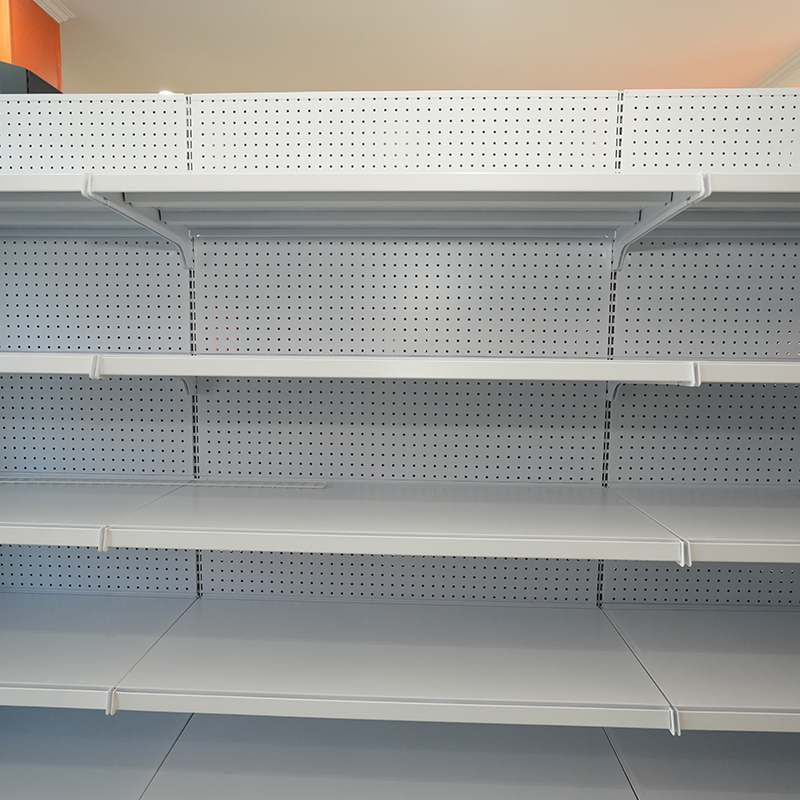 Double-Sided Supermarket Shelving Unit with Thickened Perforated Back PanelsThis 2900×1000×2400 mm double-sided rack suits center-aisle displays in supermarkets and convenience stores. Thickened perforated back panels add torsional rigidity, and adjustable shelves handle heavy items like beverages, with tool-free assembly.View Product →
Five Custom Supermarket Shelf Specifications to Lock Down in the RFQ
Five specification groups determine 90% of a custom shelf quotation: steel material, coating, load rating, back panel, and shelf pitch. Everything else in the request for quotation is a derivative of these five, so resolving them early prevents the most expensive change orders.
- Steel material and thickness. Cold-rolled Q235 steel is the standard for supermarket shelving. Specify uprights from 1.0 to 1.5 mm and shelf panels from 0.6 to 1.0 mm; heavier gauges belong in high-traffic displays and cold storage rooms where impact and condensation are constant.
- Coating system. Powder coat at 60 to 80 microns with a matched RAL colour is the retail default. Wood-grain transfer printing adds a premium surface for boutique departments, while galvanised finishes are reserved for wet areas.
- Load rating per layer. Name the heaviest SKU on each shelf type. A 120 kg per layer rating is typical for a standard gondola; reinforced mesh back-panel systems reach 160 kg per layer with tighter beam spacing.
- Back-panel construction. Flat, perforated, mesh, or wood-grain panels change hook compatibility and airflow. Perforation pitch, usually 25 mm or 50 mm, decides which accessory line fits the shelf.
- Shelf pitch and levels. Upright hole pitch at 25 mm or 50 mm defines vertical flexibility. Extra holes cost little in production and prevent expensive re-drilling in the store.
Typical rated load per shelf layer, in kilograms
Load rating is the maximum static weight one shelf layer can carry when the load is distributed evenly across the shelf board at a defined shelf depth.
Factory Capabilities: How to Verify a Custom Shelf Manufacturer vs a Reseller
A genuine manufacturer controls steel processing, welding, and coating in-house, while a reseller can only coordinate them across third parties. For a custom order, that difference shows up as tolerance drift, colour mismatch, and weeks of added lead time.
Real Manufacturer
- Owns tooling for uprights, panels, and accessory parts
- Runs laser cutting and robotic welding for consistent tolerance
- Matches custom RAL colours and private-label packing
- Accepts engineering liability for load ratings
Reseller or Trading Company
- Adds margin without adding production control
- Depends on multiple subcontractors for finishing
- Limited ability to revise drawings or change tooling
- Lead time and quality depend on whoever is available
CERS publishes the evidence openly. The factory runs an automatic shelf production line, high-precision pipe benders, tube and sheet laser cutting, and robotic welding stations, and holds operates as a national high-technology enterprise with in-house production and quality control. The factory page documents each production system, so buyers can verify capability before the first call.
Display accessories follow the same rule. Double-wire display hooks from CERS use two rods instead of one, which stops rotation and sagging on heavy packaged goods such as detergent pouches and pet food bags.
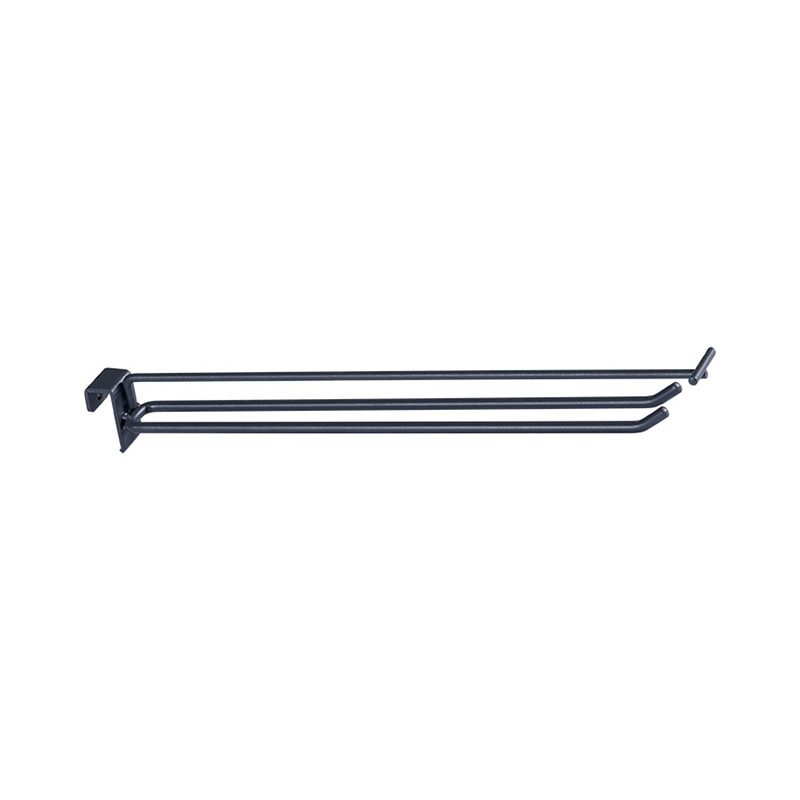
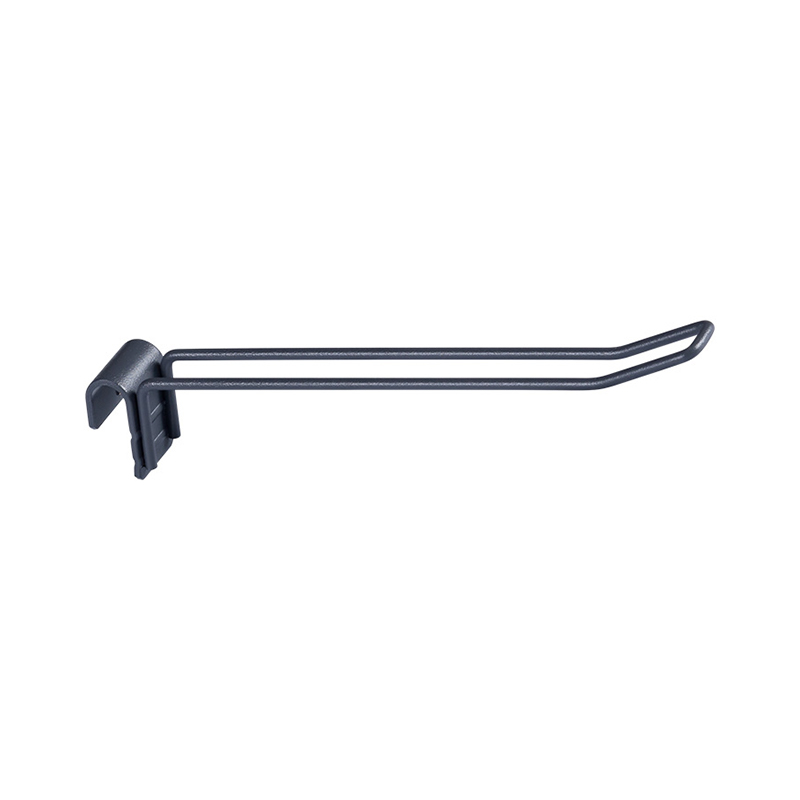 Dual-Wire Heavy-Duty Retail Display Hook with Seven Length OptionsThis reinforced hook uses two parallel wires with cross ribs to increase bending stiffness and lateral stability, preventing sagging on heavy packaged goods. Lengths range from 100 to 400 mm, ideal for dense hanging displays in retail stores.View Product →
Cost, Lead Time, and Shipping from a China Super Market Shelves Custom Factory
Plan 20 to 30 days of production after sample approval, then add 20 to 45 days of sea freight, with custom colours and private-label packing as the main cost levers.
- MOQ: No minimum order quantity for standard models. Custom colours or private labels may raise it to 200, while standard models with small changes are often accepted at lower volumes.
- Samples: 7 to 15 days including coating. Always request a production sample after bulk material is released, not just a pre-production geometry sample.
- Container planning: a 40 ft high-cube container holds roughly 1,000 to 1,200 flat-packed shelf panels plus accessories in cartons. Share the full store list so the factory can plan the container mix.
- Cost levers: standard RAL colours save coating changeover time; wood-grain transfer printing adds roughly 10 to 15 percent against plain powder coat; flat packing is the cheapest way to ship.
From Floor Plan to Store Opening: The Six-Step Custom Shelf Process
A successful custom shelf order follows six steps: floor plan, SKU data, RFQ, sample, production, and pre-shipment inspection.
Send the floor plan
Aisle widths, column positions, and ceiling height let the factory calculate shelf depths and section lengths instead of guessing.
Provide SKU data
Line weights and package dimensions decide load ratings, shelf pitch, and hook positions for every display.
Receive drawings and quotation
The factory returns engineering drawings with upright spacing, panel types, and an itemised price list for approval.
Approve the pre-production sample
Check geometry, coating colour, hole pitch, and weld quality on a physical sample built to your specification.
Run production with progress reports
Photo and video reports during welding, coating, and packing keep the order transparent.
Inspect before loading
A pre-shipment inspection covers dimensions, colour consistency, and carton packing before the container ships.
CERS's solutions team turns that floor plan into a complete display scheme, including shelf positions, hook plans, and cart requirements. Promotional flexibility matters after opening day as well; collapsible wire cages turn an empty area into a temporary feature display without bolting anything to the floor.
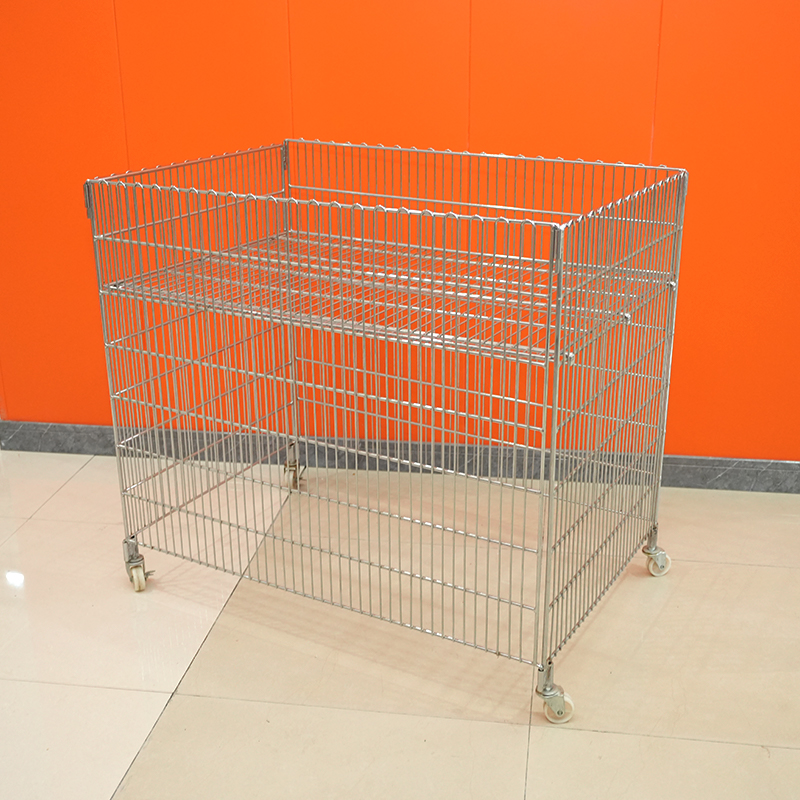 Collapsible Mobile Promotional Wire Cage for Supermarket DisplaysThis wheeled wire cage folds down to about 120–200 mm height for easy storage. Its four swivel casters with brakes allow flexible placement in aisles, and the front door opens 700 mm wide for access, making it ideal for temporary promotions.View Product →
Frequently Asked Questions About Custom Supermarket Shelving
What is the minimum order quantity for custom supermarket shelves from China?
Standard models have no minimum order quantity. Custom colours or private-label packaging may require a higher MOQ, while standard models with small changes are often accepted at lower volumes. Always confirm MOQ per model, not per container.
Can a factory match a drawing or an existing shelf sample?
Yes. A true manufacturer with laser cutting and robotic welding can replicate dimensions, hole patterns, and finishes from a drawing or a physical sample. Ask for both a pre-production sample for geometry and a production sample for coating colour.
How long does a custom supermarket shelf order take?
Sample production takes 7 to 15 days, bulk production 20 to 30 days, and sea freight to North America or Europe roughly 30 to 45 days. An order confirmed at the start of a month can realistically arrive at a warehouse eight to twelve weeks later.
What quality inspections should a buyer request before shipment?
Request three checkpoints: a pre-production sample, an in-line check of coating thickness and weld quality during production, and a pre-shipment inspection covering dimensions, colour, and packing. CERS supports all three and provides photo reports at each stage.
A China super market shelves custom factory is only as good as the specification you hand it. Send a floor plan, name the heaviest SKU, fix the coating colour, and demand engineering drawings before committing. That discipline keeps a custom project inside its schedule, and it is the exact process CERS uses to deliver complete stores across Europe, North America, and the Middle East.

- Quick Links
- Home
- About Us
- Sustainable
- News
- Contact Us
- Products
- Supermarket shelf
- Storage rack
- Shopping cart
- Shopping basket
- Shelving Accessories
- Display rack
- Contact us
-
-
+86-18852916580

-
[email protected]

-
No. 9 Yongxin Road, Wangzhuang Industrial Park, Shanghu Town, Changshu City, Jiangsu Province, China

-

