- Tel: +86-18852916580
- Suzhou CERS Commercial Equipment Co., Ltd.
- Email: [email protected]
- Tel: +86-18852916580
- Suzhou CERS Commercial Equipment Co., Ltd.
- Email: [email protected]


 Español
  عربى
عربى  Deutsch


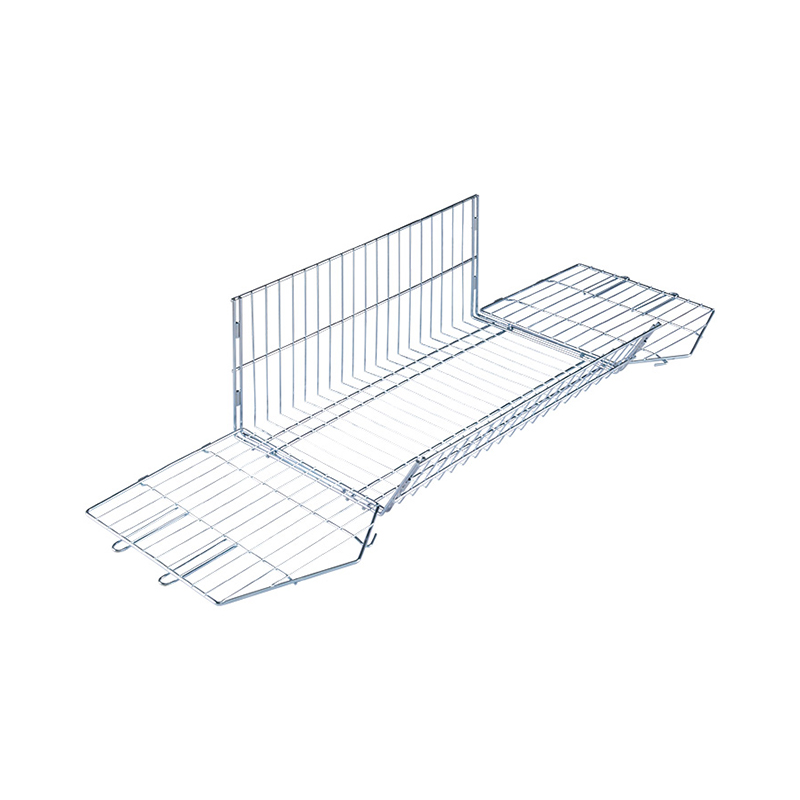
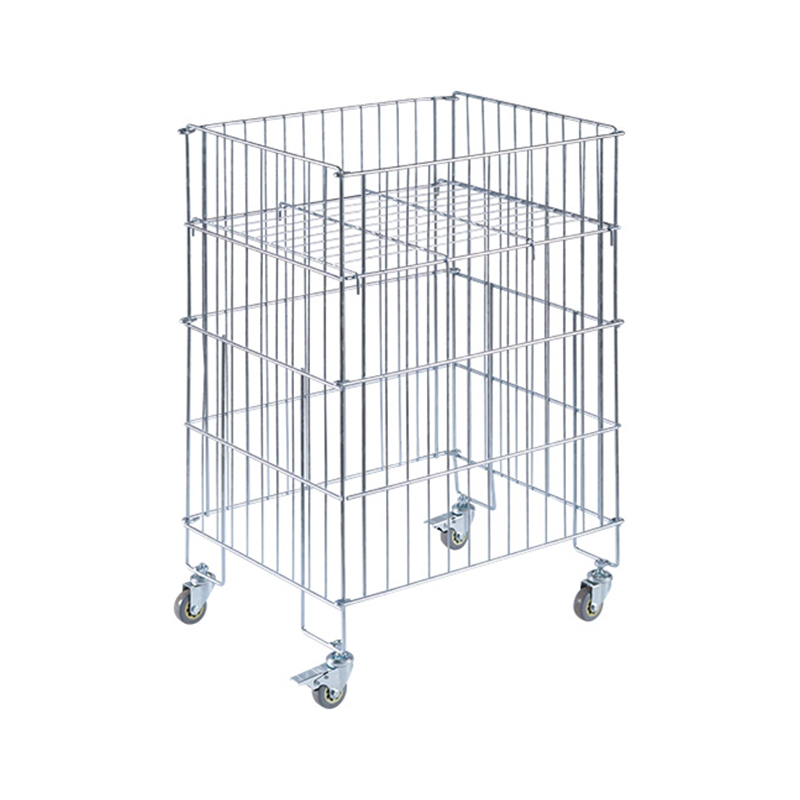
Collapsible Stacking Cage — Designed for Retail Display
This collapsible stacking cage is designed for retail display, suitable for temporary product display and storage in supermarkets, warehouse-style stores, and promotional events. The product is welded from metal wire into a cubic cage structure. Three length options are available: 900 mm, 1000 mm, and 1200 mm. The four side panels can be folded inward, reducing overall height by 70% to 80% when collapsed. Stacking posts at the four corners allows vertical stacking when empty. Suitable for displaying bagged goods, case-packed products, and promotional displays.

L: 900/1000/1200mm
Core Advantages
Collapsible structure – Left, right, front, and rear panels are hinge-connected and can be folded inward onto the base plate. Folding is manual and requires no tools. Collapsed height reduces from 300-500 mm to 80-120 mm, saving storage space during transport and non-use. To deploy, pull panels upward; hinges self-lock automatically.
Stacking function – Tapered stacking posts or nested slots at the four corners. When stacking empty cages, the upper cage's posts insert into the corresponding holes of the lower cage. Empty deployed cages can be stacked up to 4 to 6 tiers. Empty collapsed cages can be stacked up to 10 to 15 tiers, reducing floor space during retrieval and storage.
Length specification matching – Three lengths fit standard shelf panel widths and pallet sizes. 900 mm for 900 mm wide panels or 1/2 standard pallets; 1000 mm for 1000 mm wide panels; 1200 mm for 1200 mm wide panels or standard pallets. Cages can be placed on the floor, on shelf panels, or on pallets.
Retail display design – Lower front panel height (200 to 300 mm) or front door configuration allows easy customer access to products. Mesh open area: 60% to 80%, providing clear visibility of product labels and packaging fronts. Forklift slots or optional caster mounting holes in the base facilitate short-distance movement within the store.
Product Features
Material – Carbon steel wire, diameter options: 4.0, 5.0, 6.0 mm. Frame edges reinforced with thicker wire or flat bar.
Length options – 900, 1000, 1200 mm (total horizontal length of cage, excluding stacking posts).
Width options – 400, 500, 600 mm (total horizontal depth of cage).
Height options – 300, 400, 500 mm (total vertical height of cage, excluding stacking posts).
Collapsed height – 80 to 120 mm (depending on hinge positions and panel folding method).
Mesh pattern – Vertical wire spacing: 40 to 60 mm. Horizontal wire spacing: 80 to 120 mm.
Fold hinges – Heavy-duty hinges connect panels to the base and to adjacent side panels. Hinge material: carbon steel, thickness 2.0 to 3.0 mm. Hinges feature self-locking mechanisms that engage automatically when panels are deployed.
Stacking structure – Tapered stacking posts at four corners, post height 30 to 50 mm. Posts are inserted into the corner sockets of the lower cage, with a socket depth of 20 to 40 mm.
Surface finish – Electrostatic powder coating (black, gray, blue, red) or hot-dip galvanizing.
Base structure – Forklift slots (height 50 to 80 mm) or caster mounting holes (optional casters).
Load capacity per cage – 50 to 120 kg under evenly distributed load, depending on dimensions.
Accessory options – Label holder (mounts on cage front), casters (4 wheels, diameter 100 to 125 mm), rain cover, inter-cage coupling clips.
Application Scenarios
Temporary product displays (beverages, snacks, daily goods) in supermarket promotional areas.
Full-case product displays (milk cases, beverage cartons) in warehouse-style stores.
Backup product and returned goods temporary storage in retail back rooms.
Sorted goods and outgoing package temporary storage in distribution centers.
Sample display and material storage in exhibitions.
Frequently Asked Questions and Precautions
Frequently Asked Questions
Q: How long does folding and deployment take?
A: For a single operator, folding from deployed to collapsed takes approximately 20 to 30 seconds. Deployment from collapsed to locked deployed state takes approximately 30 to 40 seconds. Folding requires sequentially unlocking each panel's locking mechanism. Deployment requires pulling each panel to vertical and confirming hinge lock engagement. The hinge self-lock mechanism automatically engages with an audible click when panels reach vertical.
Q: Can cages be stacked under full load?
A: Standard design does not support stacking under full load. Loaded cages must be placed on a single tier. For stacking under full load (2 to 3 tiers), reinforced stacking cages are required (frame and wire diameter increased by 20% to 30%, stacking posts with a pin-locking mechanism), and the floor must be level with adequate load capacity. For full-load stacking requirements, provide load parameters for customization before bulk ordering.
Q: How to prevent folding hinges from loosening after long-term use?
A: Hinges are heavy-duty, with hinge pin diameters of 5 to 8 mm and nylon or metal bushings. Under normal use, hinge clearance increase is less than 0.5 mm after 1000 folding/deployment cycles. Apply light lubricating oil to hinge pins every 6 months. If a hinge becomes noticeably loose (lateral play exceeding 2 mm), replace the hinge or the entire cage.
Precautions
Do not exceed the rated load per cage. Overloading causes base deformation, hinge damage, or stacking post bending.
Before folding, empty all products from the cage. Folding with products inside causes spillage and hinge damage.
When stacking empty cages, ensure upper cage stacking posts are fully inserted into lower cage corner sockets. Partially inserted stacks may tip or collapse when moved or subjected to vibration.
Stacked height should not exceed 6 times single cage height (deployed state) or 15 times (collapsed state). Exceeding this height creates excessive pressure on the bottom cages and reduces stack stability.
When using forklifts to move stacking cages, fully insert the forks into the base forklift slots. Fork length should be at least 80% of cage depth. Single-side insertion causes cage tilting.
Inspect weld points, hinges, stacking posts, and corner sockets every 3 months. Repair or replace cages with cracked welds, loose hinges, deformed posts, or worn sockets.
Clean with a damp cloth. Cages can be pressure-washed, but avoid directing high-pressure water at hinges and weld points. After washing, deploy cages to dry, preventing water accumulation and rust.
For small products (smaller than the mesh spacing), items may fall through gaps. Use liner bags or fine-mesh liners inside the cage.
L: 900/1000/1200mm

- Quick Links
- Home
- About Us
- Sustainable
- News
- Contact Us
- Products
- Supermarket shelf
- Storage rack
- Shopping cart
- Shopping basket
- Shelving Accessories
- Display rack
- Contact us
-
-
+86-18852916580

-
[email protected]

-
No. 9 Yongxin Road, Wangzhuang Industrial Park, Shanghu Town, Changshu City, Jiangsu Province, China

-

