- Tel: +86-18852916580
- Suzhou CERS Commercial Equipment Co., Ltd.
- Email: [email protected]
- Tel: +86-18852916580
- Suzhou CERS Commercial Equipment Co., Ltd.
- Email: [email protected]


 Español
 عربى
 Deutsch



Supermarket Shelf Display China Factory: A Buyer's Guide to Sourcing Smart
Content
- 1 What Determines Supermarket Shelf Display Quality in a China Factory
- 2 Supermarket Shelf Display China Factory: Load and Stability Checks
- 3 Coating and Rust Protection in Supermarket Shelf Display Sourcing
- 4 Factory Audit Checklist for Supermarket Shelf Display Suppliers in China
- 5 Logistics, Packaging, and Lead Times From a China Factory
- 6 Supermarket Shelf Display China Factory: FAQ
Two quotes arrive for the same container of gondola shelving, and the 18 percent price gap between them is invisible in product photos. The difference appears later in bent uprights, peeling back panels, and reorders that miss a store opening date. Sourcing from a supermarket shelf display China factory requires a measurement-based checklist, not a catalog scroll.
What Determines Supermarket Shelf Display Quality in a China Factory
Steel thickness, connection design, and finish quality determine whether a shelf survives three years of daily restocking or fails in twelve months.
Most importers compare photos and prices, then find out after installation that the differences are physical. The upright post gauge controls how much weight the frame carries. The back panel gauge decides whether products push the panel out when a customer pulls a heavy item. The connection method decides how quickly a damaged section can be swapped without welding.
A typical commercial-grade gondola starts at 1.0 mm for uprights and 0.6 mm for shelves. Economy versions drop to 0.8 mm and 0.5 mm, and that 0.2 mm difference compounds across a full store: shelves deflect, columns sway, and back panels bow behind heavy goods.
| Component | Economy spec | Commercial spec | Heavy-duty spec |
| Upright post | 0.8 mm | 1.0 mm | 1.2 mm |
| Shelf panel | 0.5 mm | 0.6 mm | 0.8 mm |
| Back panel | 0.4 mm | 0.5 mm | 0.6 mm |
| Rated load per shelf | 60 kg | 80 kg | 120 kg |
A double-sided unit with perforated back panels is the workhorse of a convenience store line.
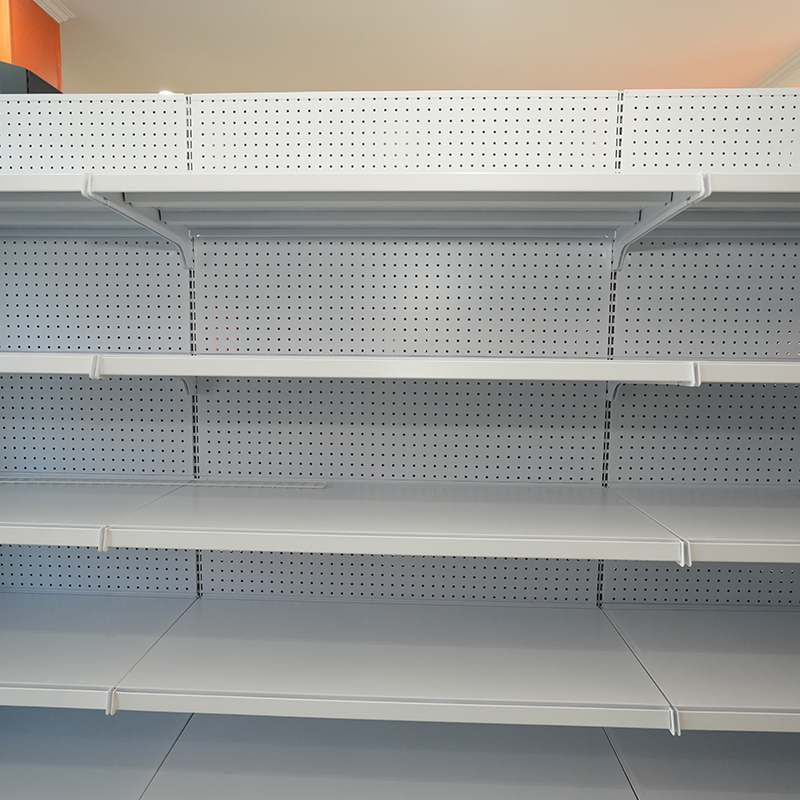 Double-Sided Supermarket Shelving Unit with Perforated Back PanelsThis 2900mm center-aisle display rack uses thickened perforated steel back panels to add torsional rigidity, supporting heavy items like beverages while allowing accessory mounting for versatile retail island displays.View Product →
Supermarket Shelf Display China Factory: Load and Stability Checks
Load ratings only matter if the structure can transfer weight to the floor without swaying.
A shelf rated for 80 kg under uniform load can fail at 25 kg under point load if the panel is thin. Test reports from a factory quote usually show uniform load only. Ask for the point-load figure and the deflection allowed at the center of a 900 mm shelf. A deflection of more than 12 mm looks unstable to customers and weakens the connection over time.
Stability also depends on the height-to-depth ratio. A 1.8 m tall gondola on a 400 mm base can sway noticeably in a busy aisle, while the same frame with a 500 mm base and a floor anchor stays firm.
For a full store layout, a factory that offers a complete store fitting solution will coordinate shelf depths, hook styles, and basket systems in one drawing package, which removes most dimensional conflicts before production.
Mesh-back heavy-duty models are the standard choice for beverage and bulk food aisles.
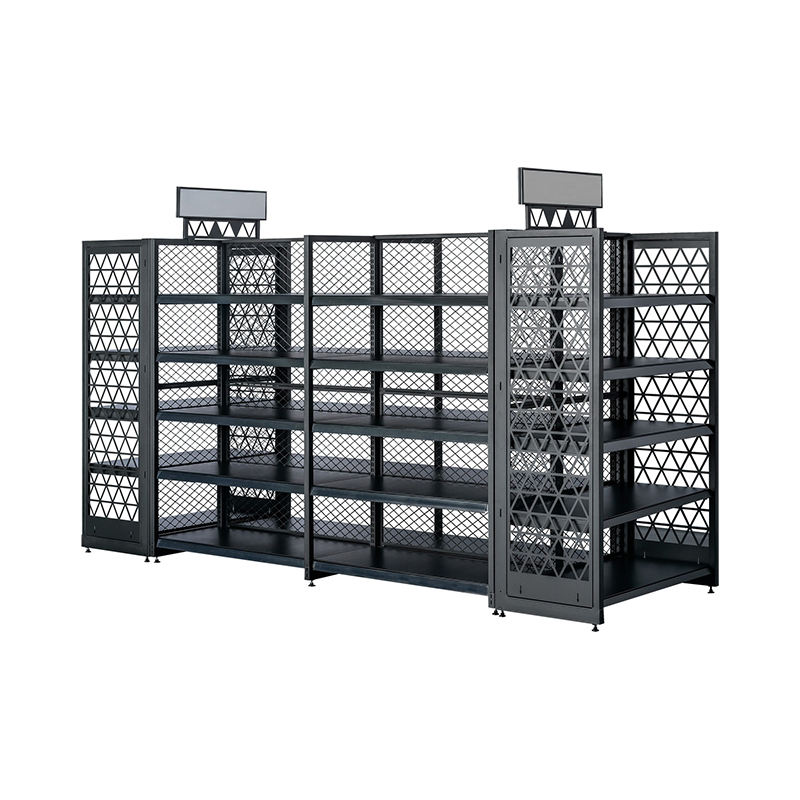 Heavy-Duty Mesh Backboard Grocery Shelving RackReinforced for oil, beverage, and bottled water displays, this multi-tier steel rack maximizes vertical space, promotes airflow, and accepts hooks and brackets, making it a durable choice for busy grocery aisles.View Product →
Coating and Rust Protection in Supermarket Shelf Display Sourcing
The cheapest coating saves money at the factory and costs revenue at the shelf edge, because rust always appears first on the busiest visible surfaces.
Bare cold-rolled steel with rust-preventive oil belongs in short-term displays, not in a store that operates seven days a week. Electro-galvanizing adds a thin zinc layer that resists minor scuffs but chips under installation impact. Powder coating, usually epoxy-polyester in a 60 to 80 micron layer, survives daily wiping with detergent and matches store brand colors. Hot-dip galvanizing is reserved for cold storage, outdoor, and coastal projects.
| Finish | Salt spray reference | Best suited for | Relative cost |
| Bare steel with rust oil | Up to 24 h | Short-term indoor display | Lowest |
| Electro-galvanized | 72-96 h | Dry gondola sections | Low |
| Powder coated | 200-300 h | High-humidity, frequent cleaning | Medium |
| Hot-dip galvanized | 500 h or more | Cold storage, outdoor, coastal | High |
Representative reference ranges based on common industry salt spray test results.
Ask the supplier for a salt spray test report on the exact coating they quote. A report on a different coating does not apply to your order.
Zinc layer of 5 to 8 microns, gray finish, low cost. It protects a dry gondola section but scratches during installation and shows humidity marks in cold areas.
Epoxy-polyester layer of 60 to 80 microns, available in any RAL color, resistant to cleaning chemicals. This is the finish most retail fixture designers specify for front-of-store visibility.
Factory Audit Checklist for Supermarket Shelf Display Suppliers in China
A factory audit that takes two hours and covers five checkpoints reveals more about a shelving line than a month of email negotiation.
You are not looking for a clean showroom. You are looking for the production line that will actually run your order.
- Verify that laser cutting machines, robotic welding arms, and a powder coating line are physically inside the facility.
- Check the material yard for steel coils with mill certificates and batch markings that match the grade quoted.
- Review incoming inspection, in-process inspection, and final inspection records from the last production batch.
- Ask for a sample cut from a finished upright and measure the gauge with a micrometer on site.
- Inspect the packing station for corner protectors, stretch wrap, and plywood case construction.
You can also ask to see the factory equipment list and compare it with what you see on the floor; equipment that exists only in documents is not equipment.
For cross-merchandising at aisle ends, an L-shaped display base extends the same shelf line without extra uprights.
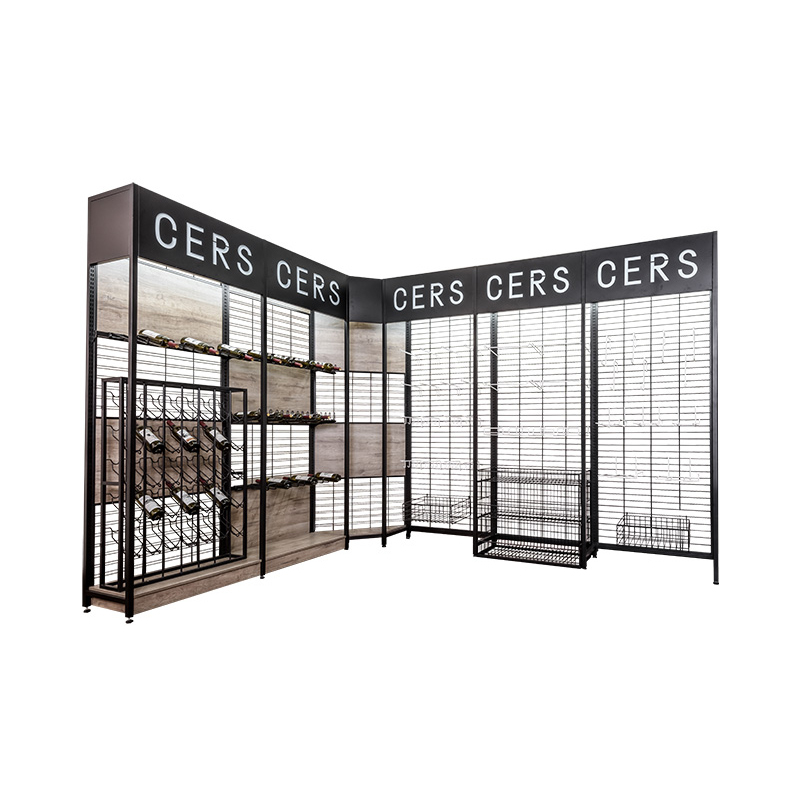 Premium L-Shaped Display Rack for Corner MerchandisingDesigned for corner spaces, this adjustable steel shelving unit extends product-facing area without extra uprights, with per-tier capacity up to 120 kg and snap-fit assembly for efficient retail reconfigurations.View Product →
Logistics, Packaging, and Lead Times From a China Factory
The lowest unit price is meaningless if the packing spec collapses in transit or the lead time misses your store opening window.
A standard timeline for a 40-foot container of supermarket shelving from a Chinese factory looks like this:
- RFQ and specification lock: 2 to 3 days after you confirm drawings, quantities, and finish colors.
- Sample confirmation: 7 to 10 days, including shipping a physical sample or receiving a photographed measurement report.
- Production: 15 to 25 days for a 40-foot container, depending on how many coating colors are in the batch.
- Packing and in-line inspection: 3 to 5 days, including loading photos and pallet counts.
- Port delivery and export paperwork: 5 to 7 days from the factory to the Shanghai or Ningbo port.
Ask for seaworthy packing in the contract. A 40-foot container of shelving that arrives with crushed corner posts costs more to repair than the saving from a thin packing spec.
Supermarket Shelf Display China Factory: FAQ
A sourcing decision is only as safe as the documentation behind it.
What is the minimum order quantity for supermarket shelving from a China factory?
Most established factories work with a 20-foot container equivalent, which is roughly 150 to 250 shelf sets depending on configuration. Some offer trial orders starting at 50 units, but the unit price will be noticeably higher and the lead time longer because tooling changes and coating batches need to be scheduled.
Can I get custom colors and logos on supermarket display shelves?
Yes. Powder coating lines can match any RAL color, and a silk screen or adhesive logo can be applied to back panels and end caps. The practical limit is order size: custom colors require a full coating batch to avoid color mismatch, so most factories expect a minimum quantity per color.
What certifications should a supermarket shelf display China factory hold?
An ISO 9001 quality management system is the entry-level requirement. For export, pay attention to whether the supplier can provide a fumigation-free plywood packing certificate, coating test reports, and material certificates that match the steel grade quoted in your contract.
How do I protect myself when importing shelving from China?
Use an INCOTERM that gives you inspection leverage, for example FOB or EXW with an on-site pre-shipment inspection, and link the final payment to the signed inspection report. Structure the payment as 30 percent deposit and 70 percent against the scanned bill of lading or inspection sign-off.

- Quick Links
- Home
- About Us
- Sustainable
- News
- Contact Us
- Products
- Supermarket shelf
- Storage rack
- Shopping cart
- Shopping basket
- Shelving Accessories
- Display rack
- Contact us
-
-
+86-18852916580

-
[email protected]

-
No. 9 Yongxin Road, Wangzhuang Industrial Park, Shanghu Town, Changshu City, Jiangsu Province, China

-

