- Tel: +86-18852916580
- Suzhou CERS Commercial Equipment Co., Ltd.
- Email: [email protected]
- Tel: +86-18852916580
- Suzhou CERS Commercial Equipment Co., Ltd.
- Email: [email protected]


 Español
 عربى
 Deutsch



China Wooden Shelves for Supermarket Manufacturers: Sourcing and Quality Guide
Content
- 1 Why China Manufacturers Dominate Wooden Supermarket Shelves
- 2 Construction Types That Define Wooden Shelf Quality
- 3 Factory Capabilities That Distinguish a China Wooden Shelf Manufacturer
- 4 Costs, MOQ, and Lead Times When Sourcing Wooden Supermarket Shelves from China
- 5 FAQ: Sourcing Wooden Shelves from Chinese Factory Partners
When a retail buyer evaluates China wooden shelves for supermarket manufacturers, three questions determine the outcome: construction quality, factory transparency, and total landed cost. This guide answers those questions in the context of the production practices at Suzhou CERS Commercial Equipment Co., Ltd., a national high-tech enterprise with a 12,000-square-meter plant about 100 kilometers from Shanghai and more than ten years of export experience serving grocery chains in Europe, North America, and the Middle East.
Why China Manufacturers Dominate Wooden Supermarket Shelves
China is the world's largest production base for commercial shelving, and the Yangtze River Delta alone supplies a major share of the wooden and steel-and-wood fixtures used in supermarkets worldwide.
Three structural advantages explain that dominance. First, the upstream chain is complete: steel coil, engineered wood panels, powder coatings, and display hardware are all available within short trucking distances, which keeps material costs low and speeds up prototyping. Second, automation is now standard in export-oriented factories; laser cutting, CNC bending, and robotic welding have replaced manual fabrication in most credible plants. Third, export logistics are mature; manufacturers sit within a few hours of Shanghai, one of the world's busiest container ports, and consolidated shipments reach most global destinations in 20 to 35 days.
Construction Types That Define Wooden Shelf Quality
The structural core of a wooden supermarket shelf, not its decorative finish, decides whether the unit survives daily restocking for ten years or wobbles within eighteen months. In practice, the most reliable format is the steel-and-wood hybrid, which this guide defines as a display unit in which a steel frame carries the load while wooden or wood-grained panels supply the visual surface.
Four construction types dominate the market, and each suits a different store segment:
- Steel posts with solid wood boards: the most common hybrid; the steel frame carries the load, and the timber supplies the warm surface. Load rating depends on post gauge, board thickness, and the span between supports.
- Steel frames with melamine-faced MDF: a cost-efficient option for convenience stores; the moisture-resistant face layer handles chilled aisles better than raw veneer.
- Wood-grain steel back panels: a decorative wood finish applied to perforated steel, combining timber aesthetics with metal resilience and air circulation; widely used on single-sided and double-sided wall units.
- Full-wood display units: heavier, more expensive, and lower in load capacity; typically limited to boutique, organic, or premium store segments.
| Construction | Load capacity | Moisture resistance | Finishing cost | Best fit |
| Steel posts + solid wood boards | High | Moderate | Mid | Mainline grocery aisles |
| Steel frame + melamine-faced MDF | Medium-high | Good | Low to mid | Convenience stores |
| Wood-grain steel back panel | High | Excellent | Mid | Deli, bakery, wall displays |
| Full-wood display units | Low to medium | Low | High | Boutique and organic stores |
For general merchandise aisles, CERS produces a double-sided steel-and-wood combination shelving unit that pairs steel uprights with wooden shelf boards, balancing metal durability with a warm presentation surface.
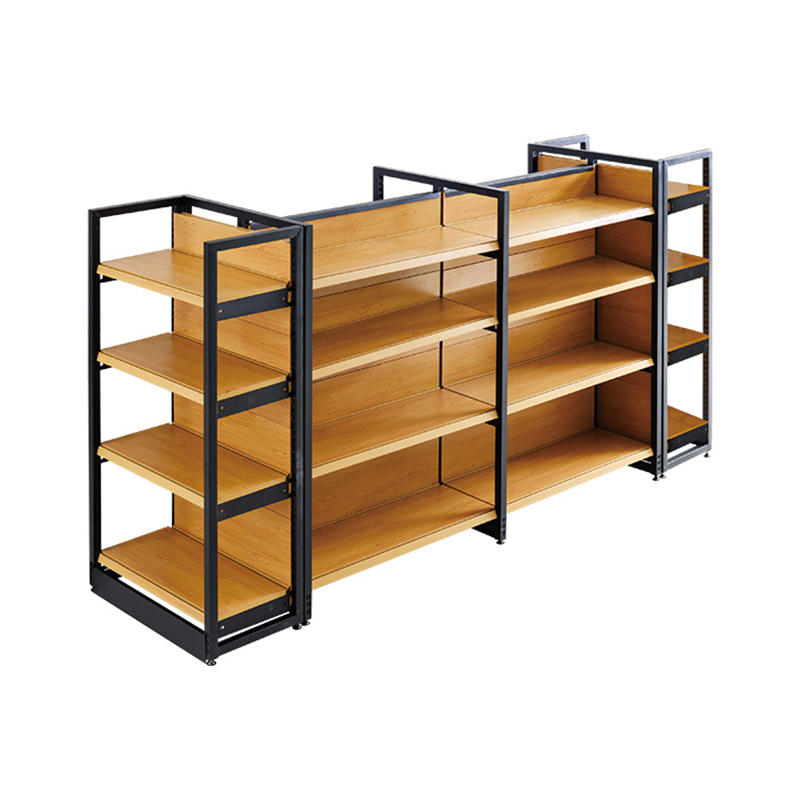 Double-Sided Steel and Wood Combination Shelving Unit for SupermarketsThis center-aisle shelving unit uses a welded cold-rolled steel frame with a wood grain transfer finish, offering a durable yet warm presentation for dry goods and daily necessities.View Product →
Factory Capabilities That Distinguish a China Wooden Shelf Manufacturer
A manufacturer's in-house production equipment tells you more about wooden shelf quality than any catalog rendering, and a reliable factory is transparent about its material sources and testing procedures.
Use this five-point audit when evaluating a Chinese factory partner:
- Check certification scope: ISO 9001 should cover manufacturing, not just trading activity, and export inspection reports should match the destination market.
- Trace the material chain: confirm steel sheet gauge, wood board grade, and adhesive type before signing, and ask for mill certificates on major components.
- Watch the welding and coating lines: robotic welding and a controlled powder-coating process produce consistent frames, while manual-only lines vary from batch to batch.
- Demand a load test: have sample shelves loaded to 1.5 times rated capacity and measure deflection; do not accept visual inspection alone.
- Inspect export packaging: edges, corners, and wood panels need corner guards, stretch film, and palletization built for a 25-day sea journey.
Buyers who audit production in person or by live video report fewer quality disputes than those who purchase purely from catalogs. The CERS factory runs automated rack production lines and robotic welding systems, and the company opens its floor to scheduled inspections before order confirmation.
For convenience formats, CERS offers a wood-grain double-sided display rack that combines the timber look with perforated steel back panels, a configuration that keeps high-turnover products ventilated and visible.
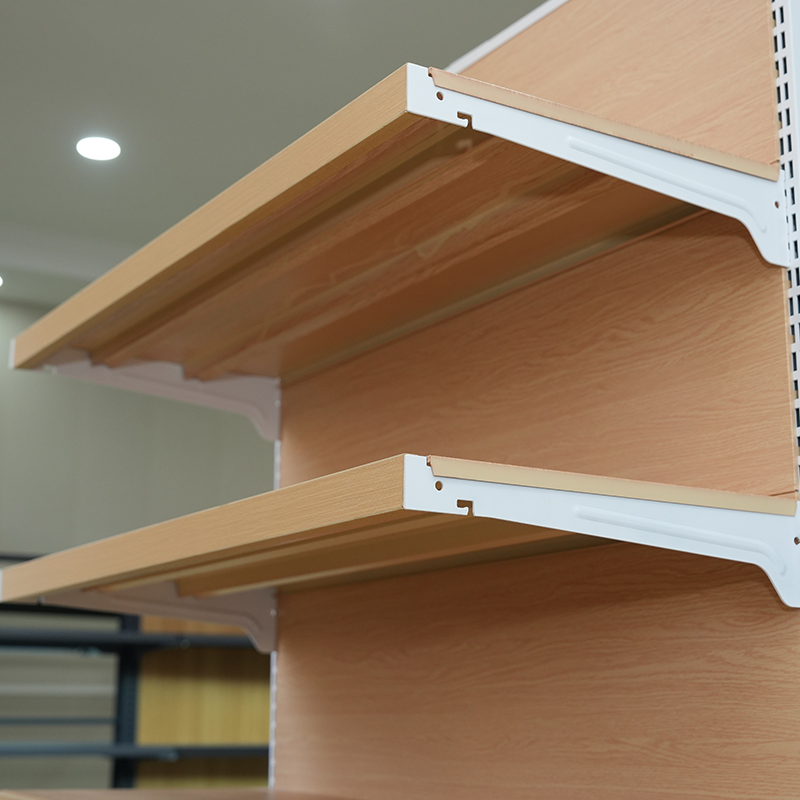 Convenience Store Wood Grain Double-Sided Display RackA double-sided metal rack with a powder-coated base and wood grain transfer top layer, designed for high-turnover products in convenience formats while combining strength and visual appeal.View Product →
Costs, MOQ, and Lead Times When Sourcing Wooden Supermarket Shelves from China
Budgeting a Chinese wooden shelf order means planning around three numbers: unit price, minimum order quantity, and total lead time from purchase order to port of discharge.
For standard steel-and-wood systems, manufacturers typically quote a minimum order quantity of 50 to 200 units per model, production lead times of 25 to 45 days, and ocean freight of 20 to 35 days to Europe or North America. Payment terms usually follow a 30 percent deposit with the balance settled against the bill of lading; established factories also accept letters of credit at sight. Custom heights, shelf depths, and wood-grain finishes are routine, but they extend lead time by 7 to 14 days and raise per-unit cost by 5 to 15 percent.
The chart explains why material specification drives price: switching from melamine-faced MDF to solid wood boards, or upgrading the powder-coating specification, moves the largest cost line, not the labor content.
For a truthful budget number, send your store layout and target budget to the CERS team to request a tailored quotation with line-item pricing and freight options.
For premium grocery lines, the double-sided display stand with a wood-grain back panel adds an upscale presentation layer without sacrificing metal durability.
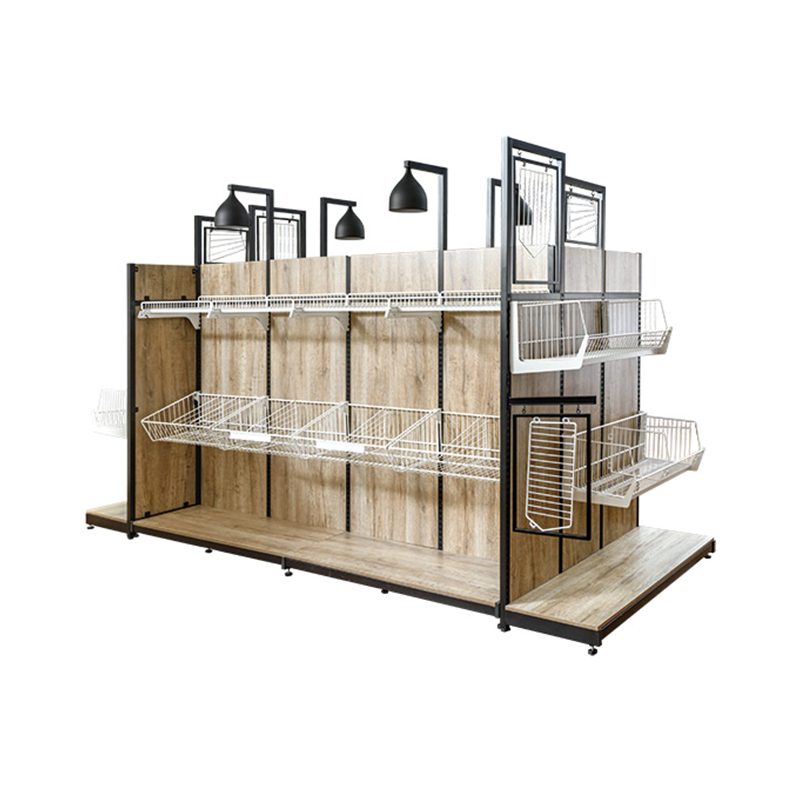 Premium Double-Sided Display Stand with Wood Grain Back Panel and Hanging BasketsThis customizable display stand pairs a wood-grain finished back panel with hanging baskets on both sides, suited for snacks, general merchandise, and small-batch retail displays.View Product →
FAQ: Sourcing Wooden Shelves from Chinese Factory Partners
What is the typical MOQ for wooden supermarket shelves from Chinese manufacturers?
Standard steel-and-wood systems usually carry a minimum order quantity of 50 to 200 units per model. Highly customized shelves with unique sizes or finishes may require higher minimums, while standard catalog models from established manufacturers can often be ordered in smaller batches.No minimum order quantity for standard styles.
How long does manufacturing and shipping take from China?
Plan for 20 to 30 days of production plus 20 to 35 days of ocean freight to Europe or North America, for a typical total of seven to eleven weeks. Air freight is available for urgent fill-in orders but increases the freight cost sharply.
How can a buyer verify quality before paying a Chinese supplier?
Three steps cover most of the risk: check the ISO 9001 scope of the factory, run a live video or on-site audit of the production and coating lines, and commission a third-party load test plus pre-shipment inspection on sample units.
Can Chinese factories customize wood finishes, sizes, and branding?
Yes. Melamine, veneer, wood-grain steel, custom heights, shelf depths, and private-label branding are routine capabilities. Customization typically adds 5 to 15 percent to unit cost and extends the production lead time by one to two weeks.

- Quick Links
- Home
- About Us
- Sustainable
- News
- Contact Us
- Products
- Supermarket shelf
- Storage rack
- Shopping cart
- Shopping basket
- Shelving Accessories
- Display rack
- Contact us
-
-
+86-18852916580

-
[email protected]

-
No. 9 Yongxin Road, Wangzhuang Industrial Park, Shanghu Town, Changshu City, Jiangsu Province, China

-

