- Tel: +86-18852916580
- Suzhou CERS Commercial Equipment Co., Ltd.
- Email: [email protected]
- Tel: +86-18852916580
- Suzhou CERS Commercial Equipment Co., Ltd.
- Email: [email protected]


 Español
  عربى
عربى  Deutsch


Supermarket Shelving Systems: A Technical Comparison of Types, Materials, and Customization
In the competitive landscape of modern retail, the choice of supermarket shelving systems plays a pivotal role in defining both the operational efficiency and the shopping experience. Shelving is not merely a storage solution; it is a strategic tool that influences product visibility, customer flow, inventory management, and ultimately, sales performance . For manufacturers, distributors, and retailers, understanding the technical distinctions between various shelving types, materials, and customization levels is essential for making informed procurement decisions. This article provides a comprehensive technical comparison of supermarket shelving systems, focusing on the critical factors that differentiate performance, durability, and long-term value.
Supermarket shelving must accommodate a vast array of product categories, each with unique size, weight, and display requirements. The modern supermarket shelf must be versatile enough to handle everything from lightweight snacks to heavy beverage cases, while also supporting dynamic merchandising strategies. Furthermore, the shelving system must withstand the rigors of high-traffic retail environments, including frequent stock replenishment, customer interaction, and cleaning. This article examines the key considerations that differentiate supermarket shelving systems, including type selection, material performance, and the trade-offs between standard and custom solutions.
These performance benchmarks are not arbitrary; they are the direct result of material selection, engineering design, and manufacturing quality. To appreciate the technical considerations involved in selecting supermarket shelving, it is helpful to first understand the fundamental differences between the primary shelving types used in retail environments.
With the fundamental principles in mind, we can now examine how different shelving types, materials, and customization options impact the overall performance and cost-effectiveness of a supermarket shelving system. The following table summarizes the key differentiators across these critical dimensions.
| Feature | Gondola Shelving | Wall Shelving | End Cap Displays | Specialty Shelving |
|---|---|---|---|---|
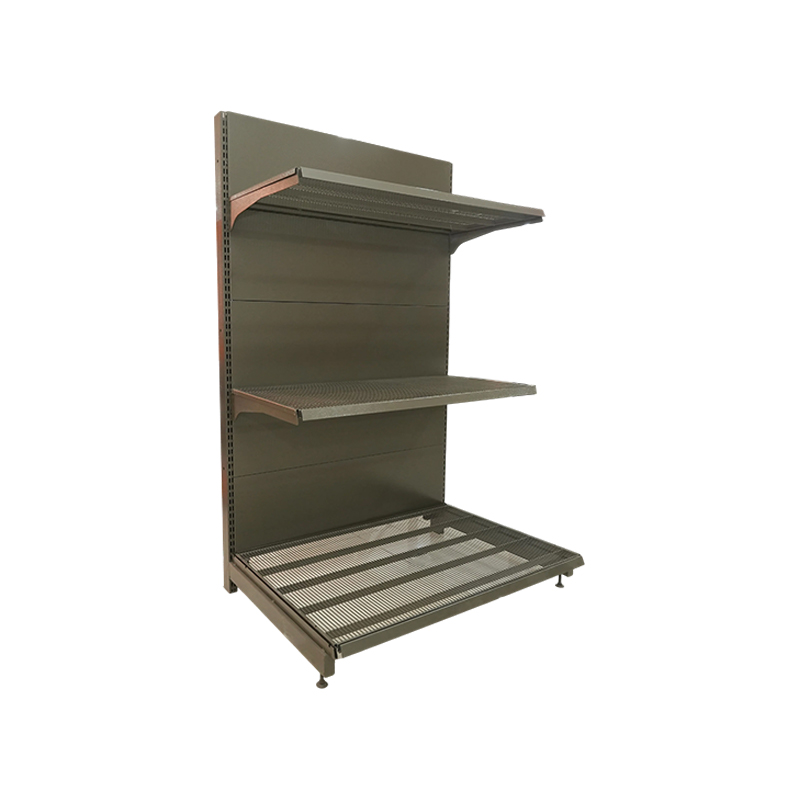
| Primary Application | Center aisle, general merchandise | Perimeter walls, heavy/bulky items | Aisle ends, promotional items | Fresh produce, refrigerated goods, bulk items |
| Design Configuration | Double-sided, freestanding | Single-sided, wall-mounted | Single-sided, short length | Custom shapes, materials |
| Primary Material | Steel (powder-coated) | Steel, sometimes wood | Steel | Stainless steel, glass, plastic, wood |
| Key Feature | Adjustable shelves, high visibility | Maximizes vertical space | High visibility, strategic placement | Customized for product needs |
| Accessibility | High (both sides) | Moderate (front access) | High (end of aisle) | Varies by application |
Beyond the basic types, the material selection for supermarket shelving is a critical decision that affects durability, hygiene, maintenance, and aesthetics. Metal shelving, typically made from steel or aluminum, offers exceptional durability and strength, making it ideal for heavy loads and high-traffic environments . Steel shelving is resistant to warping, cracking, and decay, ensuring a long lifespan that justifies the initial investment. For environments where corrosion is a concern, such as refrigerated or produce sections, stainless steel provides superior resistance [citation:5]. Aluminum offers a lightweight alternative with good corrosion resistance, suitable for modular systems that require frequent reconfiguration .
While metal dominates the supermarket shelving market, other materials are used for specific applications. Wood shelving offers natural beauty and charm, often used in boutique or high-end settings to create a premium aesthetic. However, wood is generally less durable than metal, more prone to water damage, and requires more maintenance [citation:5]. Plastic shelving, commonly made from high-density polyethylene, is resistant to moisture, corrosion, and rust, making it suitable for refrigerated sections or humid environments. However, plastic may not offer the same load-bearing capacity as metal or wood, making it more appropriate for lighter items .
The choice between custom and standard shelving systems represents another significant decision point for retailers. Standard shelving systems are pre-configured units designed for general-purpose use, often supplied in fixed dimensions with limited modification options . The main advantage of standard shelving is simplicity and lower upfront cost, making it suitable for small stores, temporary spaces, or back-of-house storage Custom supermarket shelving, by contrast, is designed around the specific requirements of a retail environment, including floor plan, product mix, customer flow, and merchandising goals . Custom systems offer significant advantages in layout flexibility, shelf capacity, product presentation, future expansion, and overall customer experience .
Frequently Asked Questions
- Storefit. (2025). "Supermarket Shelving Solutions: A Comprehensive Buyer's Guide."
- DCShelves. (2023). "How Do Metal Supermarket Shelves Compare to Other Materials?"
- Heda Shelves. (2024). "What are the Different Types of Supermarket Racks?"
- Mills Shelving. (2026). "Custom Supermarket Shelving vs Standard Shelving Systems."
- EYDA Storage. (2022). "What is the difference between warehouse rack and supermarket rack?"
- Krost Shelving. (2025). "Selective Storage Racking or Gondola Shelving: Right One?"

- Quick Links
- Home
- About Us
- Sustainable
- News
- Contact Us
- Products
- Supermarket shelf
- Storage rack
- Shopping cart
- Shopping basket
- Shelving Accessories
- Display rack
- Contact us
-
-
+86-18852916580

-
[email protected]

-
No. 9 Yongxin Road, Wangzhuang Industrial Park, Shanghu Town, Changshu City, Jiangsu Province, China

-

